<?xml version="1.0" encoding="utf-8"?><feed xmlns="http://www.w3.org/2005/Atom" ><generator uri="https://jekyllrb.com/" version="3.10.0">Jekyll</generator><link href="/feed.xml" rel="self" type="application/atom+xml" /><link href="/" rel="alternate" type="text/html" /><updated>2026-03-11T11:40:36+00:00</updated><id>/feed.xml</id><title type="html">Laura Lungu</title><subtitle>PhD Student at University of Cambridge.</subtitle><author><name>Laura Lungu</name></author><entry><title type="html">An Intitute for Ethical AI</title><link href="/blog/ethicalAIinstitute/" rel="alternate" type="text/html" title="An Intitute for Ethical AI" /><published>2024-03-21T08:08:43+00:00</published><updated>2024-03-21T08:08:43+00:00</updated><id>/blog/EthicalAI</id><content type="html" xml:base="/blog/ethicalAIinstitute/"><![CDATA[<p>Rapid advancements in AI pose <strong>ethical challenges</strong>(e.g.bias, fairness) and <strong>security threats</strong>(e.g. existential risks, privacy issues) across a variety of sectors, and without a breadth of assessment they’re unlikely to be solved.  Current AI safety methods are not incorporated in the system design but act as a  post-processing step (i.e. reinforcement learning through human feedback) starting with established AI safety standards and guidelines applied to systems.</p>

<p><strong>There isn’t a structure in place to comparatively assess these methods</strong>, and no way to actively integrate feedback/metrics from a variety of stakeholders. These standards are often established by computer scientists or engineers and do not involve transparent, public consultation. This means that there are limited avenues for the public to contribute to deciding what values are embedded in AI systems, and may fail to adequately reflect a diverse range of expertise needed for specific applications. For instance, within the healthcare sector, input datasets frequently exhibit a bias towards specific racial groups, resulting in AI models trained on such data producing insights that may not be applicable to individuals outside the group in question.</p>

<p>The obvious follow-up questions are then: <strong>can we develop methods to systematically test different strategies for AI safety to see if systems act in line with pre-established, embedded values?</strong> How can we develop values in a way that ensures transparency and input from various public stakeholders? What is the best strategy to ensure that testing the performance of AI safety strategies at fulfilling values within a simulated environment is reflective of how these systems would work in practice?</p>

<p><strong>We need an institute to research AI safety methods (constitutional AI, RLHF, etc.) in a comparative manner using metrics that reflect consensus across stakeholders from a range of specialties and demographics.</strong> The optimal solution is to use a sandbox (a virtual testing  environment) where we ensure standards accurately reflect real-world conditions to portray AI behavior in actual scenarios. Without releasing it into the world, where it could cause harm, we want to test very broad metrics  in the artificial environment while ensuring output accurate to the real world. This is the technical challenge our institute fundamentally wants to address, with the ultimate goal of incorporating these ethical guidelines into the model building, as part of system design.</p>

<p>Crucially, our goal is to bridge our insights with Big Tech companies, AI safety organizations, and government bodies, establishing a feedback loop for perpetual improvement of our models. We aim for our expertise to be shared widely, enabling any institution focused on AI safety to access our resources and contribute to ongoing research. A collaborative approach would be at the heart  of this institute, which will have regular discussion panels bringing state of the art researchers together to formalize future directions.</p>]]></content><author><name>Laura Lungu, Samia Mohinta, Somsubhro Bagchi</name></author><category term="jekyll" /><category term="update" /><summary type="html"><![CDATA[Rapid advancements in AI pose ethical challenges(e.g.bias, fairness) and security threats(e.g. existential risks, privacy issues) across a variety of sectors, and without a breadth of assessment they’re unlikely to be solved. Current AI safety methods are not incorporated in the system design but act as a post-processing step (i.e. reinforcement learning through human feedback) starting with established AI safety standards and guidelines applied to systems.]]></summary></entry><entry><title type="html">The Value of a Messy Place</title><link href="/blog/messyplace/" rel="alternate" type="text/html" title="The Value of a Messy Place" /><published>2022-10-15T08:08:43+00:00</published><updated>2022-10-15T08:08:43+00:00</updated><id>/blog/MessyPlace</id><content type="html" xml:base="/blog/messyplace/"><![CDATA[<p>Jordan Peterson will say you won’t get anywhere unless you’re at least able to make your bed, ‘If you want to change the world, start with your room’, he says. After all, if you can’t even keep your personal space together, how could you possibly expect to handle the messiness and randomness of the world?</p>

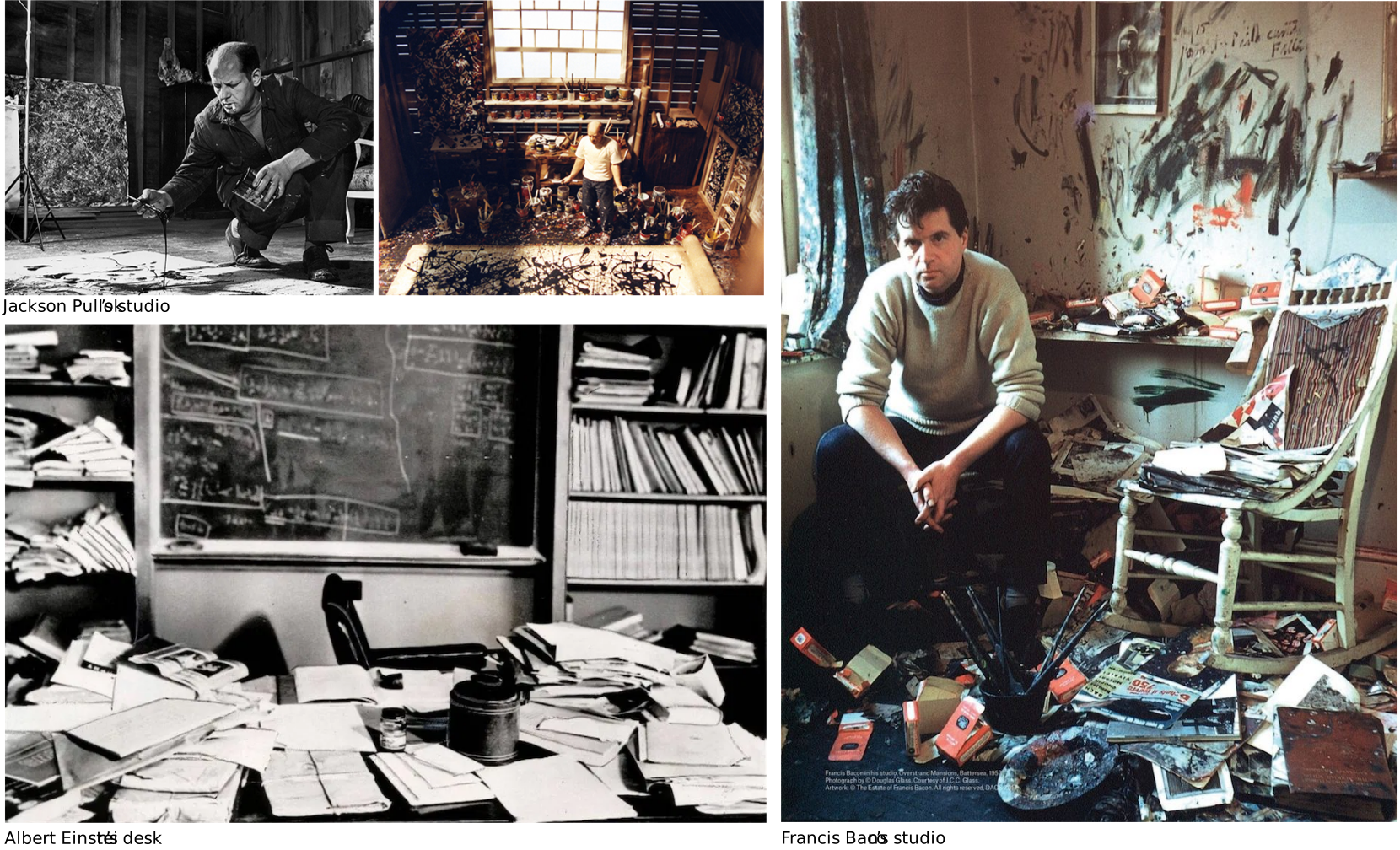
<p>But I have some contradictory evidence to that:</p>

<p><img src="/images/artists.svg" alt="room" /></p>

<p>I’m not here to convince you that living a disorganised life is the way to succeed. Rather, I’m here to argue that a messy environment isn’t such a big deal, and can be, in fact, an interesting and valuable experience to have; for some, even inspiring.</p>

<p><strong>The missconceptions</strong></p>

<p>The assumptions one makes when overestimating the value of a clean environment are:</p>

<p>An <em>organised living space is the reflection of a clear mind -</em> while true for some, it’s <strong>definitely not a rule</strong>, and I’d argue it’s more a correlative than a causal relationship.  This is certainly untrue for many scientists - if you see the working spaces of many, you’ll notice it’s not at all representative of how clear their goals/thoughts are from a scientific perspective, and not at all reflective of how established of a scientist they are. If you’re looking for a correlation though, you’ll find the opposite to be true.</p>

<p><em>A</em> <em>clear mind leads to a successfull life</em> - your thoughts and feelings <strong>need not be at their clearest for you to succesfully go about your life</strong>. Understanding them is a highly dynamic process, and simply never-ending, but it’s also a beautiful one.</p>

<p>Even if these two assumptions were true, it’s quite a jump to say an organised living space leads to a successfull life. For the most part, that’s simply not true. You can be incredibly excited for a project, and so emersed in it that you completely forget about the external world. Only when you’re done you come to the realisation that your place is, well, a mess. Isn’t that a sign that your project was successful though?</p>

<p><strong>Finding inspiration in the world’s tendency to disorder</strong></p>

<p>There’s plenty of remarkable people who, regardless of the environment they’re put in, have clear goals and produce valuable work. Jackson Pollok, Francis Bacon and Albert Einstein are only a few of many. What these people have managed to do is deal with the entropy around them without the need to diminish it, or fight it. This is quite an exceptional skill to have, since there are indeed times you just can’t escape entropy, and your life must go with it. As an example, consider being stuck in traffic: there’s simply nothing you can do to escape the waste of time and interference that will cause. However, must that affect your general wellbeing? We fight disorder everyday, but there’s no reason to be averse to it. Whether that be an ocasional messy room, a loud library, a moment of sadness, or any other imbalances life invariably brings.</p>

<p>Some even find a bit of mess inspiring -  particularly artists. Besides being unpleasant to navigate, a mess is a sign we are doing stuff - we’re here, we’re moving things, we live with them and we use them. It’s our mark in time, and can be a good indicator of our ideas. Besides, who wants a place that’s never been touched? One analogy I can come up with is the after-party nostalgia:it’s a nuiscance to clean up after a crazy party, but the mess is what reminds you of the great time you had with your friends.</p>

<p>Nature is disorder. Every season has its elements of mess and beauty;  right now, in autumn, leaves are piling over the pavement, the air is stingy and days are getting shorter - but for that, you get a scenery of vibrant colors,  golden streets, and rosy cheeks. 
Ultimately, life is a never ending entropic environment, but why should laws of nature negatively affect our wellbeing, when we can allow it to shape us in a positive manner.</p>]]></content><author><name>Laura Lungu</name></author><category term="jekyll" /><category term="update" /><summary type="html"><![CDATA[Jordan Peterson will say you won’t get anywhere unless you’re at least able to make your bed, ‘If you want to change the world, start with your room’, he says. After all, if you can’t even keep your personal space together, how could you possibly expect to handle the messiness and randomness of the world? But I have some contradictory evidence to that:]]></summary></entry><entry><title type="html">What on earth is Connectomics</title><link href="/blog/whatisconnectomics/" rel="alternate" type="text/html" title="What on earth is Connectomics" /><published>2022-07-26T16:08:43+00:00</published><updated>2022-07-26T16:08:43+00:00</updated><id>/blog/Connectomics</id><content type="html" xml:base="/blog/whatisconnectomics/"><![CDATA[<p><img src="/images/flybrain.gif" alt="brain gif" /></p>

<p>Whether or not you heard about the term, you definitely heard about the scientific conundrum behind <strong>connectomics</strong>: how do networks of <em>billions</em> of neurons and <em>trillions</em> of connections in our nervous system produce actions, thoughts, emotions and memories? Well, connectomics aims to answer just that! By means of advanced neuroimaging techniques including, most notably, electron microscopy and functional magnetic resonance imaging, the goal is to map connectomes of human and non-human animals, to unravel the structural basis of behaviour.</p>

<p>What is a <strong>connectome</strong>, you ask? Put simply, a <em>connectome</em> is the complete set (<em>ome</em>) of neural connections in a central nervous system. The addition of the suffix <em>omics</em> simply indicates the study of an <em>ome</em>, so that’s connectomics, the in-depth study of biological systems’ connectomes. Now that we got etymology &amp; definition out of the way, let’s answer the big questions: <strong>how do we even build a connectome</strong>; <strong>what does it tell us</strong> and <strong>why is all that useful</strong>?</p>

<p>The first step in building a connectome is finding an organism worthwhile exploring. The human brain is the obvious choice here, however, I’ll explain shortly why this isn’t the most popular one. Notable examples of non-human animal models include the fruit fly Drosophila, the roundworm C. elegans and the mouse. The next step is to map the central nervous system (CNS) of your model of choice. This can be done in one of two ways:</p>

<ol>
  <li>
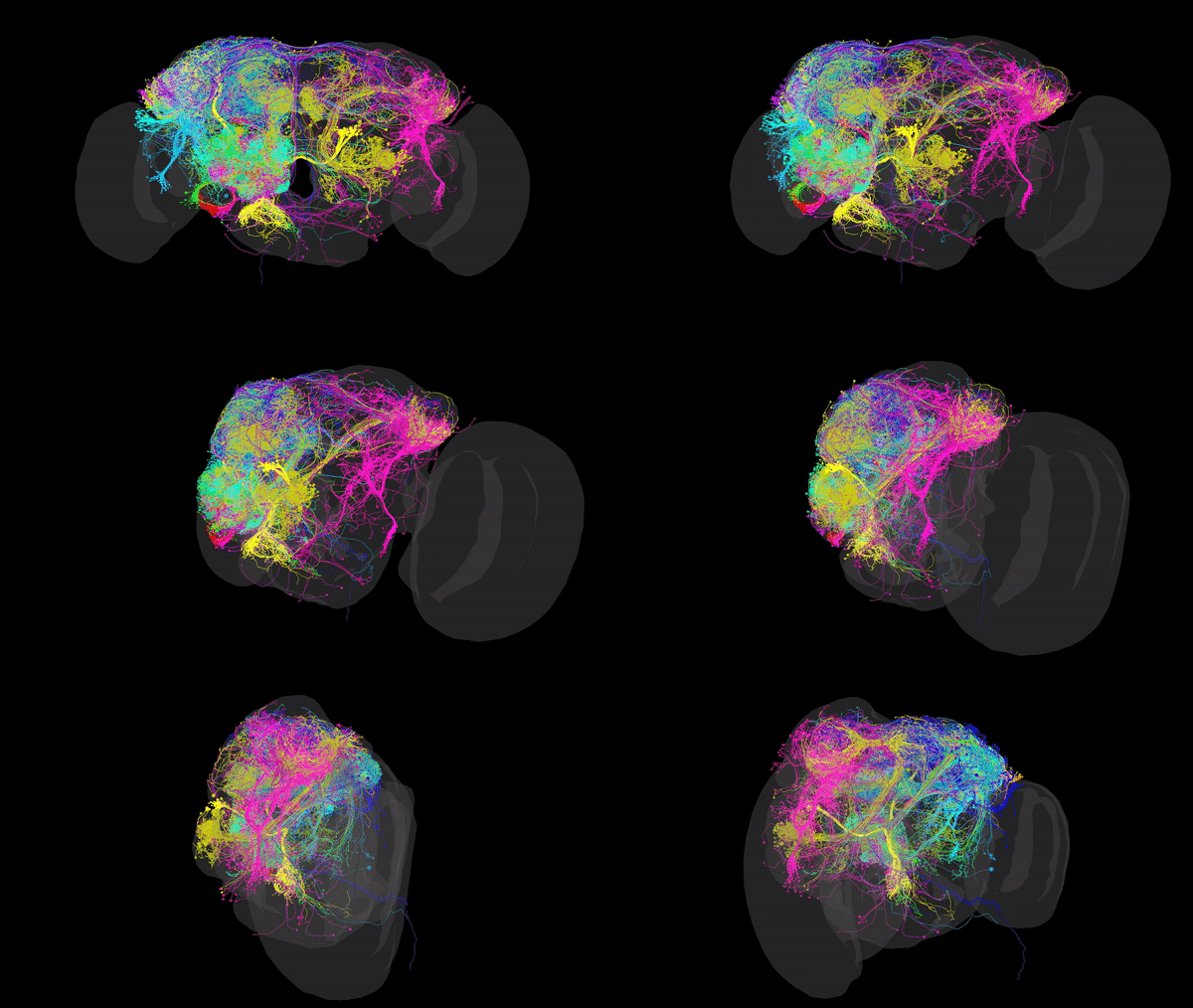
    <p>Via Electron Microscopy (EM), where tissue is sliced into very thin sections (~4nm) and scanned via an electron beam that can reach resolutions of up to 10nm, allowing us to distinguish <strong>morphology, organelles</strong> and even <strong>individual synapses.</strong> Using this data, one can reconstruct the complete set of neural connections within a CNS into a comprehensive 3D map (such as the one in the image above), that packs valuable anatomical and connectivity-related information. This is especially useful when inferring the role of restricted neural pathways in specific behaviours.</p>
  </li>
  <li>
    <p>The second option is via Functional magnetic resonance imaging (or fMRI), which measures brain activity according to changes in blood flow, such that increased blood flow in one region indicates increased activity in the area of interest.</p>
  </li>
</ol>

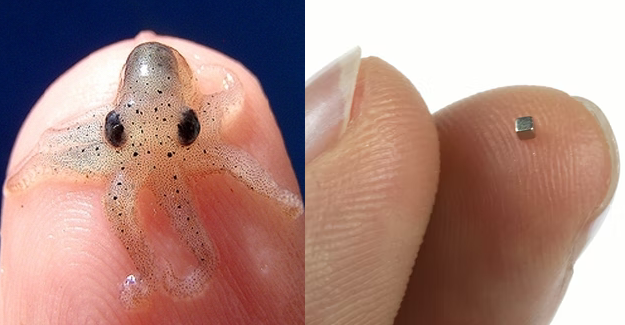
<p>EM data tends to be preferred for its high resolution, but acquiring an EM volume and turning it into a comprehensive 3D map is no mundane task. I’ll describe this technique in further detail at one point, but to paint the picture: it takes the best electron microscope <strong><em>today</em></strong> <strong>approximately</strong> <strong>1 year to image 1 cubic millimetre</strong>. This is roughly the size of a pygmy squid brain (below is an image of both for reference).</p>

<p><img src="/images/squidcube.png" alt="Image 1" /></p>

<p>So for small, simple organisms like <em>C.elegans,</em> with roughly 300 neurons and 7,600 synapses, reconstruction was possible early on. In fact, the first-ever fully mapped connectome was that of <em>C.elegans</em> back in 1986 (<a href="https://www.sciencedirect.com/science/article/pii/S0166223618302443">John White and colleagues</a> at the <a href="https://www2.mrc-lmb.cam.ac.uk/">MRC Laboratory of Molecular Biology</a>, University of Cambridge), and you can find this data <a href="https://wormwiring.org/index.html">here</a>. Subsequently mapped (though incompletely) connectomes include the zebra fish (100 000 neuronst; at <a href="http://fishatlas.neuro.mpg.de/zebrafishatlas/main_page">Max Planck</a> Institute), the bumblebee (1 million neurons), the locust, and, an animal that has received a lot of attention across scientific disciplines, the fruit fly <strong><em>Drosophila</em></strong>(with 100 000 neurons).</p>

<p>When it comes to humans, EM is unfortunately not the best option at present, for 2 main reasons: 1st, brain preparation for imaging requires living samples, and 2nd the human brain is so huge it would take a very long period of time to acquire sizable data. Since 1 mm³ takes about a year to image, and the human brain has roughly 1.3 million mm³, that means it would take about 1.3 million years to have the entire brain mapped by EM; and that’s without reconstructing the connectome (<strong>86 billion neurons</strong> and about 100 trillion connections). But suppose we had that data at hand, genetically manipulating human brain cells to link them to a specific function still wouldn’t be ethically feasible.</p>

<p>For this reason, fMRI is the current state of the art technique when it comes to human connectome data. The mission of mapping the human brain is currently pursued by <strong><a href="http://www.humanconnectomeproject.org/about/">The Human Connectome Project</a></strong>: the first large-scale attempt to collect connectomics data from individuals in vivo. Although this technique does not reach nearly as high resolutions as EM, its discoveries are very much noteworthy.</p>

<p>Since bridging the gap between neural structure and function is a central dogma in neuroscience, you can imagine that connectomics will have important implications for two major fields: medicine and computation. Connectomics is a useful tool to unravel the structural causes of neurological disease and to gain insight into psychopathologies. In addition to that, connectomes help us develop computational models of whole-brain dynamics which can contribute to AI ai and Machine learning (e.g. algorythms implemented by biological brains can be appied to graphs) (<a href="https://www.annualreviews.org/doi/pdf/10.1146/annurev.neuro.28.061604.135637">P.Vogels et al.</a>, <a href="https://arxiv.org/abs/2204.00323">Mullakaeva et al.</a>, <a href="https://arxiv.org/abs/1611.08699">J Brown, et al.</a>).</p>]]></content><author><name>Laura Lungu</name></author><category term="jekyll" /><category term="update" /><summary type="html"><![CDATA[]]></summary></entry></feed>